
THE SYMBOLIST ORIENTATION TO EGYPT
A Formal Orientation within the Symbolist Tradition of R. A. Schwaller de Lubicz and John Anthony West
A Perceptual Orientation to Giza, Luxor, Karnak & Abydos
Immediate Access
If you don’t know how to see Egypt, you won’t see it.
Most people travel to Egypt and leave with photographs, impressions, and fragments of explanation.
The architecture was not built to be admired. It was built to organize perception.
Without a framework, temples feel overwhelming. Reliefs appear decorative. Anomalies remain unresolved.
This Orientation restores that framework.
You will learn how to move through sites, read proportion and axis, and recognize symbolism as structural design rather than ornament.
Egypt does not hide itself.
It assumes a trained observer.
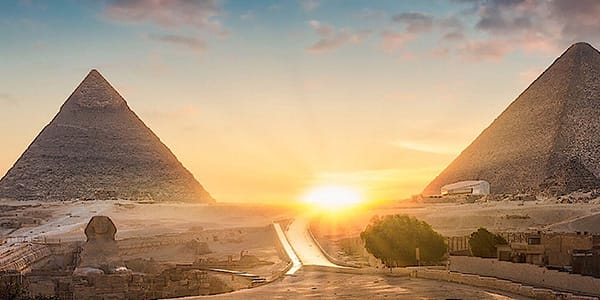
Module I — Giza
Scale, anomaly, and the limits of linear progress.
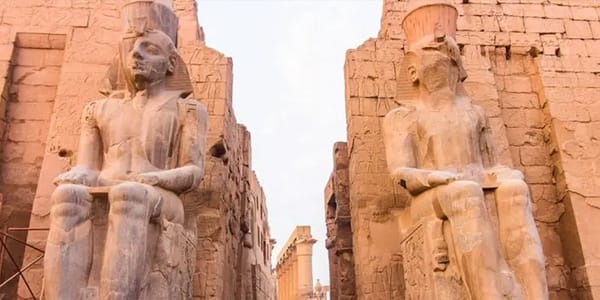
Module II — Luxor
Architecture as a model of the human form.
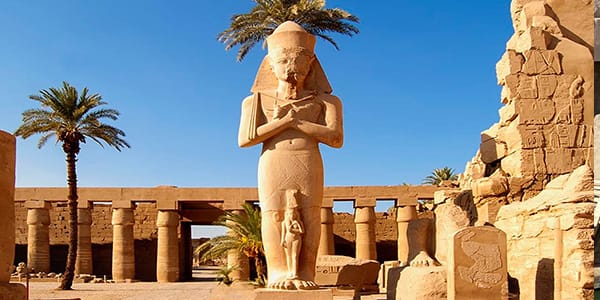
Module III — Karnak
Power, accumulation, and kingship organized in stone.
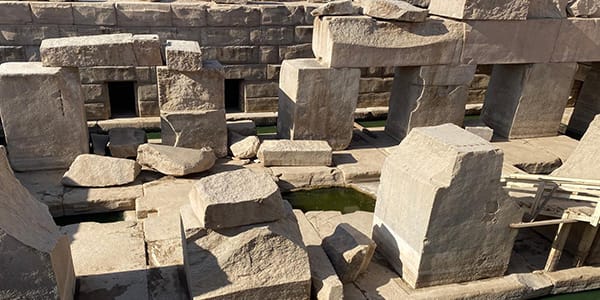
Module IV — The Osirion
A structure that does not behave like dynastic Egypt.
0WHY THIS MATTERS
Understanding Egypt before you arrive changes everything.
Understanding Egypt before you arrive changes the experience entirely.
Most visitors move through temples impressed but disoriented. Without a framework, the architecture registers as scale rather than structure.
This Orientation ensures that intention, coherence, and meaning register while you are there — not years later through books and reconstruction.

Content
Continuity
Clarity
Comprehension

Arrive Oriented
So the sites register as intelligible structures, not overwhelming ruins.

See Coherence
Understand how temples, tombs, and landscapes form a unified system rather than disconnected monuments.

Avoid the Tourist Fog
Move beyond surface explanations, trivia, and confusion before you step foot in Egypt.

Experience Egypt in Real Time
Meaning registers during the visit itself, not only afterward through reading and reflection.
The Orientation Series Includes
Four structured orientation modules
Each devoted to one major region of Egypt: Giza, Luxor, Karnak, and Abydos.
Designed to be completed prior to travel
So you arrive oriented rather than overwhelmed.
Immediate access to full recordings
Watch at your own pace. Revisit as needed.
Curated film selections from the Magical Egypt Symposium
Supplementary material selected to reinforce the interpretive framework established in the modules.
Who This is for
This is for:
• Those planning a journey to Egypt who want to arrive oriented rather than overwhelmed
• Travelers who seek structural understanding, not disconnected facts
• Viewers drawn to coherence, proportion, and disciplined interpretation
• Students of the symbolist tradition who prefer method over mythology
This is not for:
• Those looking for tour logistics, packing lists, or itineraries
• Readers seeking an encyclopedic survey of dynasties and dates
• Consumers of sensational claims or fringe speculation
• Visitors satisfied with awe alone
How this works
The material is presented in a deliberate progression.
Each module builds upon the last, establishing the perceptual framework necessary for what follows. Understanding develops cumulatively — not as scattered insights, but as a coherent structure.
You move through the sequence as designed.
No prior background in Egypt is required.
Curated Lectures
The course includes these Magical Egypt Symposium Lectures
Sacred Science and the Symbolist Mind: Egypt Beyond History
John Anthony West argues that ancient Egypt was founded on a symbolic, initiatory science radically different from modern materialism—and that misunderstanding this symbolic mode has blinded us to Egypt’s true purpose and antiquity.
Engineering the Impossible: Precision, Power, and the Lost Technologies of Ancient Egypt
Christopher Dunn shows that Egyptian pyramids and statuary display machine-level precision and functional design, proving ancient Egypt possessed advanced technologies far beyond the hand-tool narrative.
The Giza Template: Sacred Geometry, Harmonics, and the Lost Science of Ancient Egypt
Ed Nightingale argues that the Giza Plateau was engineered as a precise geometric and harmonic template encoding advanced scientific knowledge about energy, cycles, and planetary processes, rather than serving solely as tombs or monuments.
symposium ed nightingale
The Djed, 23.5 And The Zodiac - A Conspiracy To Control Or A Pathway To Liberation
Gary Osborn, Ike Rodriguez, and Thomas Joseph Brown argue that the Djed pillar, Earth’s 23.5° axial tilt, and the zodiac together form a deliberately engineered system that can either be used to condition human consciousness—or, once understood, to restore alignment, agency, and liberation.
The Symbolist Orientation to Egypt
Four Foundational Modules
Permanent Access
This is not a tour companion.
It is the framework required to encounter Egypt as it was designed to be encountered.
If you intend to visit Egypt — or to understand it seriously — this Orientation establishes the necessary ground.
$197
Stay Connected

Magical Egypt
Email: vanese@magicalegypt.com


Links
Home
Contact us
About us
Built with systeme.io
Terms | Privacy